Check out my interview by Miki Johnson of liveBooks:
http://tinyurl.com/yejsxe3Renowned conservation photographer
Robert Glenn Ketchum was honored as an American Master in the March/April 2010 issue of
American Photo magazine. As he sees it, this might mark the beginning of the end of the reign of postmodernism and the rise of photography that looks at the natural world as much as the human one.

©Robert Glenn Ketchum
Miki Johnson: So tell me about the American Photo magazine American Masters issue and how you found out about it.
Robert Glenn Ketchum: I didn’t know anything about it. Russell Hart, one of the editors at American Photo, has previously written about several of my projects and has convinced the other editors that I was worth a page or so every once in a while.
But American Photo has, without being mean to them, pretty much concentrated three-quarters of the magazine on individuals who are primarily fashion and people shooters. And the Masters Series had reflected that. There’s only been four others nominated to the series in 20-years of the magazine being published: Henri Cartier-Bresson, Richard Avedon, Helmut Newton and Annie Leibovitz — all people and personality photographers. So it’s exciting to be in such a distinguished group of imagemakers, and even moreso to be included as someone who’s focused on the environment and made photos of the landscape more in the style of Adams or Porter.
Russell called me up, offered the possibility of the feature, and asked for a personal timeline of my projects, books, etc. The task was informative and breathtaking because I’d never put together such a thing for myself. It helped me see how lucky I’ve been to have been involved with so many projects that had positive effects. The conclusion of the timeline provided some serious reflection on that moment back in the ’60s in a Redwood forest on the California coast when I decided to make pictures of the landscape — then to flash all the way forward through those projects to where we are now. Wow! That’s the manifestation of dreaming your own existence, the proof it works.
MJ: Looking back at all of those results, are there any insights that jump out about how you achieved them?
RGK: One we’ve talked about previously, and I think the most significant one, was that I took this traditionally popular item, the coffee table book, and turned it into an advocacy tool. And not just by writing a more didactic text and adding difficult pictures, which I did. Also by learning how to publish it cost effectively and get it out there and use it in the media. If I’d have walked away from any of those publications after they were published, they wouldn’t have done anything. But because I embraced the whole cycle of the performance, it made them more useful.
It also created a system. So with each project the system got more refined and increasingly effective. And certainly now that’s where we are with the Bristol Bay campaign. We have powerful books, and we already have had one relative legislative success. And we’re pushing on.
Now with an acknowledgment like this for me from this magazine, it makes me an even more undeniable force, doesn’t it? You know, if Barbara Boxer already was impressed and invited me into her office before, how about now?
It’s a kind of self-fulfilling prophecy. I would be foolish not to leverage this attention to create advocacy on behalf of the environment.
At the opening of the American Photo article Masters Series, Russell writes, “Robert Ketchum may be one of the least known photographers in America, but he may also be one of the most influential.” I’ve done a lot of this stuff under the radar and I’ve done it on my reputation among a small network of people. Perhaps now my reputation has a bigger window.

©Robert Glenn Ketchum
MJ: Tell me a little about your background as an artist and your decision to approach photography from a more activist position.
RGK: When I came into photography, I had come out of a really prep high school and into UCLA, where I was required to take art classes. At first I thought I was threatened because “art” was something I had not done much of previously. Then I became very interested in the history of art, and I got involved in the design program. The design program led me to photography.
The teachers at UCLA at that time were spectacular, at the leading edge of the ’60s avant guarde movement in photography on the West Coast. That scene had it’s own unique kind of cult and cache. It was grounded in an eclectic base that included Paul Outerbridge, William Mortenson, Edward Weston, Ansel Adams and the F64 school, and all this other stuff going on which my UCLA teachers, Edmund Teske, Robert Heinecken and Robert Fichter fed upon.
I entered UCLA in 1966, and it was an exciting time to be making art. I got the opportunity to pay some of my bills by shooting rock ‘n’ roll bands, so that’s what I was doing. In college I also encountered the writings of Aldo Leopold and Rachel Carson and the campus organizers of the Sierra Club.
On the way back from the Monterey Pop Festival, some friends and I stopped at a canyon in Big Sur called Limekiln Creek to camp. I got up in the next morning and after a solitary walk next to a stream in the quiet of the morning forest, I had one of those epiphanal moments. I heard the words of Aldo Leopold, suggesting that we had a moral obligation to protect our environment because it was the thing that keeps us alive. And Rachel Carson, who said, all the bad things we put out into our environment will eventually come back to us as poisons, and I thought, WOW, if I could make pictures serve those ideas, that would be a really great thing.
I didn’t jump into being an environmental photographer overnight; it took another 15 years of evolution and thought. But that was the moment when I started working towards it. And not just to make picture books, but make advocate tools. I still view photography as this fantastically adaptable medium, and even more so now that digital is upon us. Once photographic imagery is transcribed into digital information, you can print in concrete, you can embed in glass, you can print on fabric, you can weave it into looms. This is territory no one has explored much before.
If you look back at UCLA in the ’60s, it was going on then — and then postmodernism came in. And postmodernism took charge, in terms of molding the cultural mindset and conscripting the idea behind all grant giving and all exhibition coordinating. After the arrival of postmodernism, only a few of us would even touch nature and certainly not as a source of beauty.

©Robert Glenn Ketchum
If you look at postmodernism’s stars such as Jeff Koons, one of the most significant of the early postmodernists, his work is sculptures of Michael Jackson and pop icons, or huge sculptures of his wife and him making love to each other. Postmodernism reflected by Annie Leibowitz is about the cult of personality and in Cindy Sherman who assumes hundreds of witty guises throughout her work — it is basically all about ME. Postmodernism for me is about the cult of ME and US. And yeah, it can be very fun, and cerebral, but more importantly, it has pretty much controlled what the American public has seen in the gallery and art museums for the last 35 years.
After UCLA I got my masters from Cal Arts, which was one of the birthing places of postmodernism, so I totally get it. I don’t mean to put it down. It’s a perfectly viable language within the arts. But for me it was sterile because it was just a language within the arts.
“It just seemed that my response as an artist should embrace these bigger issues in my life.”
I saw a new world coming at us with a changing environment and the promise of new media connectedness and what it meant to print and publish and do all this other stuff. And I saw the rise of the environmental movement in the early ’70s and how photography could serve it. It just seemed to me that my response as an artist should embrace serving these bigger issues in my life, and that the language and the conversation of this world was much bigger than that of the more rarefied art world.
I remember having this talk with myself, saying if you do this, the art world may ignore you. But if you succeed in the environmental community and you can actually save these lands you’re trying to save, would you trade that for all the fame? And the answer to that was, yes I would. Just make me an effective photographer that can drive real social issues and I will accept whatever it is I get out of that. And I went ahead and I did that work. And I never allowed the indifference from the postmodernist community to disrupt my own working tenor.
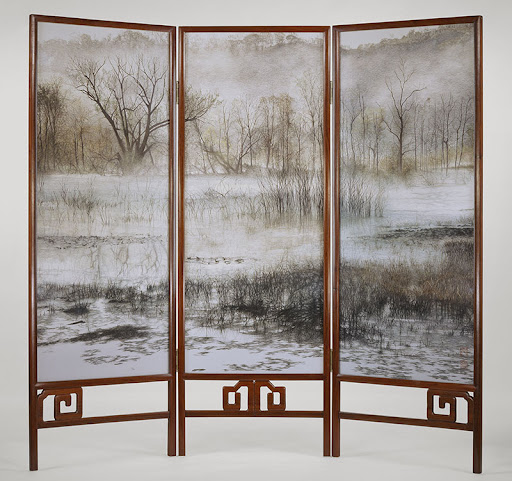
At the same time, I never stopped practicing photography in a more experimental way. So I have pieces that are now starting to be shown at Basel, Miami, that are 72 inches tall by 14 feet wide. They’re still based in nature, but they’re highly manipulated. I have also been doing textiles in China, hand-embroidered screens and standing screens and wall hangings based on my landscape photographs. I’ve been doing those for 30 years, and they are finally starting to get exhibition attention.

"The Beginning of Time." Random stitch embroidery, silk thread and watercolor on silk gauze. ©Robert Glenn Ketchum
These may not be how the postmodernist world perceives important art as being made, yet if I were to look back over the last 40 years and say, what was really important? Was it that Jeff Koons did these amazing sculptures of himself having sex? Or was it putting a million acres of old-growth forest into protective status in the Tongass, or adding 60,000 acres of land to Saguaro National Monument resulting in it getting upgraded to a national park, or keeping Mitsubishi out of one of the only Gray whale birthing lagoons in the world at St. Ignacio, Baja? Do I feel that one of those two directions was more important, to me ultimately, and it should be to the public as well? Yeah, I do.
And there’s other amazing work being done by my brothers at the International League of Conservation Photographers, too. Guys like Frans Lanting, who has been knighted by his country for his conservation work, and Jim Balog, who was nominated for a McArthur genius grant this year.
I think the work we’re doing (iLCP and others) is going to be held in higher regard in retrospect than it is right now. That’s why I say, I’m very flattered just to be included with these four “master” photographers who so clearly represent a different point of view than mine. Beyond that, just to have American Photo acknowledge me as a photographer and an artist of some repute may give me more traction in academic circles that haven’t seem to notice what I have been doing or hold it with much regard.
You know to me, in some ways post modernism was a dumbing down. It accepted an artists political point of view as long as it was cleverly hidden in intellectual reference, but seemed uncomfortable with putting the message undeniably in people’s faces where it might actually do some good. Exhibits that didactic might anger patrons and cost institutions contributions. Post modernism certainly gave us some outrageous shows and ones that stirred controversy but did they really do anything in the public arena besides create a fashionable buzz?
Photography is SO powerful, why not use it to its fullest power and exploit all of the ways it allows us to express ourselves. Look at Eugene Smith’s book about his wife’s cancer. Or pretty much any photographs Sebastião Salgado takes of people who are misplaced or victimized. I have never wanted to give money to beggars on the street because I’m never sure that it isn’t just for booze. But when I see Salgado’s pictures of world crisis circumstances, I have a whole new take on poverty and would like to see money given there. It’s an amazing power that his best photographs have.
In a way, therein lies the difference between the work I do and the postmodernist movement. The comparison here is the difference between Annie Liebovitz’s work and Salgado’s. They’re both taking pictures of people, but they have VERY different ideas about how those pictures will get used and what it is hoped those pictures will inspire.
That’s what I did. I had a different idea about what was important to my life, how my art might serve those issues, and how to use the work through the emerging mediums to expand the exposure of the ideas to evermore people. Postmodernism didn’t serve me in getting that done and has chosen to dismiss my efforts as journalistic, and not art. I supposed the textiles and the new digital prints are viewed as aberrations of old age.
We all do what we think we have to do.